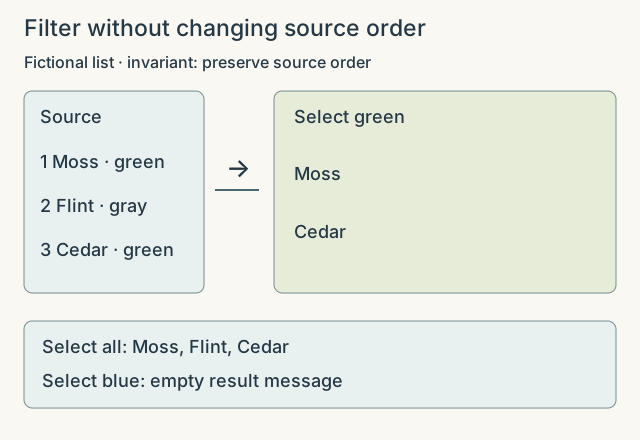
The change flight card is a compact planning worksheet developed for this concept. It contains a destination, examples, an invariant and a stopping condition. It is not a substitute for testing in the actual environment. The following fictional list feature demonstrates the method without claiming that an application has been implemented or tested.
01
Write the four-part card
Destination describes the visible behavior in one sentence. Examples give concrete inputs and expected outputs. The invariant states something the change must preserve, such as the original order of matching items. The stopping condition states what must be reviewed before the task is considered complete. Add an environment note when the behavior depends on a library or runtime. Keep implementation choices in a separate area so the brief remains readable if the eventual solution uses a different approach from the first sketch.
02
Work through a fictional filter
Suppose the fictional list is Moss tagged green, Flint tagged gray and Cedar tagged green, in that order. The destination is filtering by an exact tag. Selecting green should produce Moss followed by Cedar; selecting all should restore all three items; selecting blue should produce an empty result message. The invariant is preserved source order, not alphabetical order. These examples expose a possible mistake: sorting the matches would add behavior that the brief never requested. They also distinguish no matches from a failed data load.
03
Review the boundary before expanding
The stopping condition might require checking the three examples, keyboard access to the selector and the visible empty state in the actual interface. Record which checks were performed and which remain pending. Only after that review should a second brief introduce multiple tags or search text, because either changes the combinations that need attention. A small card helps contributors agree on a finished increment. It also preserves a useful explanation when a future maintainer asks why the filter keeps its original order rather than sorting results.
Illustrative reference for CodingPilot. The example is fictional. Scroll the diagram horizontally on smaller screens.