Programming work often becomes difficult before any code is written: the intended change is vague, the example is missing or several unrelated goals have been combined. CodingPilot is a name for making the next step explicit. It could support educational exercises, project notebooks or practical review guides.
01
Start with an observable outcome
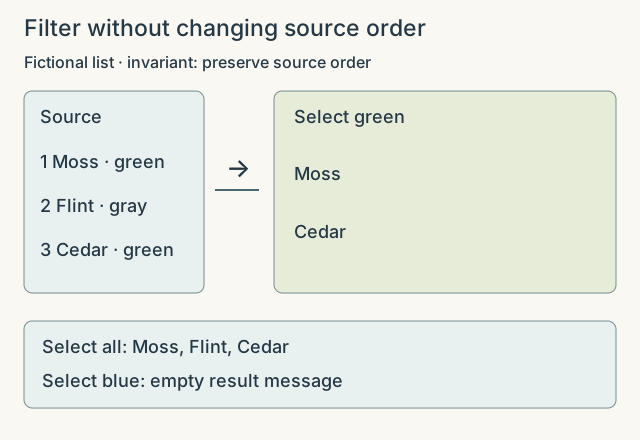
Replace an instruction such as improve the list with an example of what should happen. A user selects a category, sees matching items and can return to all items. That description suggests inputs, outputs and boundaries without prescribing an implementation prematurely. A useful brief also names what is outside this change, such as editing item details. Keeping those edges visible helps a learner finish one coherent task and gives a reviewer a fair basis for deciding whether the change meets the stated purpose.
02
Several ways to use the name
CodingPilot could be a library of small programming exercises organized by the decisions they teach. It could be a personal development journal showing how a feature evolved, or a collection of review worksheets for teams. A learning library needs clear prerequisites; a journal needs honest distinctions between experiments and released code; review worksheets need examples that can be checked. None of these directions requires claims about an autonomous assistant. The strongest starting point is a modest format that people can inspect and reuse.
03
Show the reasoning in the artifact
A short before-and-after example can explain a change more clearly than a long feature list. Include an empty input, an ordinary input and one boundary case relevant to the task. Avoid presenting every conceivable case as equally important. The goal is to identify the uncertainty that could invalidate the intended behavior. If the environment cannot be run, record that limitation. A plausible-looking code sample is not evidence that it executed successfully, and a completed explanation should not blur that distinction.
Illustrative reference for CodingPilot. The example is fictional. Scroll the diagram horizontally on smaller screens.